

If you’ve spent time at home with little ones, then you might know what it’s like to feel like a ship being tossed about in the open sea, defenseless against the waves. If you’ve ever thought to yourself “What is happening?!”, and got the urge to run for the hills, I see you. I have been through some seriously chaotic days myself. And, look, I’m not here to say that chaos is to be avoided. In fact, throw that idea right out the window as if you’re holding toxic waste. Chaos is beautiful. Chaos is normal. Chaos all the time is, well…chaotic and unsustainable. Over time, however, we learn how to structure our days to cultivate a more nourishing, balanced flow. I’m here today to share what that looks like and a simple trick that is likely to bring significantly more peace into your day.
As with most things in life, balance is key. What I’ve found is that there’s a sweet spot, a delicate balance of control and release I needed to learn in order to best support my little ones. In this balance, we’ve found significantly more peace and enjoyment in our days together.
Rhythm and how it differs from routine.
To gain a little more insight into what this looks like, I feel like it’s important to distinguish between routine and rhythm which are subtly different, but equally important. You might be thinking they are the same. They’re not.
Routine is the backbone of a nourishing daily flow. Routines refer to the (mostly) fixed and repeated actions that occur within a given time. Daily examples include meal times or brushing teeth before bed (though my kids would argue that the latter doesn’t need to happen at all). These daily anchors are important for early child development because kids feel safe when they know what to expect. Control, in this case, is beneficial in that creating consistency by establishing routines helps keep a nurturing environment grounded in safety.
Now, a rhythm and routine might seem like the same thing on the face of it in that they are both patterns of actions. However, a subtle difference exists. A rhythm is alive, living and more changeable. It’s gentle and flexible.
I maintain that the Waldorf lovely in how it respects natural child development, and one of the reasons I feel this way is because the Waldorf’s style acknowledges the importance of these rhythms. Waldorf describes this rhythm as an ongoing cycle with alternating periods of inhales (contraction) and exhales (expansion). There is a beautiful balance in such a rhythm and it can create so much peace.
| Inhale (Contraction) | Exhale (Expansion) |
|---|---|
| Time for quiet, focus, or rest | Time for freedom or spontaneity |
| Cuddles, chores, handiwork crafting, songs, story time, literacy or math work | Movement, creative play, indoor or outdoor free play, swinging, balancing, spinning, or running |


Respond to your child’s needs with flexibility
The beauty of this rhythmic style is in its free-flowing, flexible nature. When we are inflexible about our daily schedule, we can brush up with friction. When I decided to try homeschooling my oldest, a preschooler, it took some time to figure out how to begin to build more focused literacy and math work into our day. While we only devote a small amount of time to this work, it didn’t always feel like we were moving in harmony. Nap time was our first shot at “school work” because that’s what I thought made sense given my youngest toddler was sleeping. I was dished a plate of big fat no. It was oftentimes a disaster. Come nap time, my oldest was ready to jam. He was not ready to work through literacy and math practice; he was needing freedom.
Nap time was the most convenient time for me. I told myself the lie that it was the most convenient time for him to do letter or number work, but really it was my own need for control of the situation. Enter the need to let go.
As it turns out, there was a more optimal time for focused work which, for him, is earlier in the day after he’s able to take a great big out breath with free play. The vast majority of the time we head outside, which has become an integral component in our day.

To be clear, heading outside right after breakfast wasn’t always my favorite. Helping the kids get into their winter gear is…difficult for me. However, brushing up against the friction we experience when the kids’ don’t get the post breakfast free play they need, is also difficult. A good friend recently reminded me of one of my favorite mantras: “choose your hard”.
A hard truth
Here’s the thing: we are the adults. We have the fully formed brains and are therefore more adaptable, flexible, and able to take struggles in stride-hopefully. It is our responsibility to be reasonably flexible in order to meet our children’s changing needs. That’s not to say that our needs don’t matter, by all means take that break when you need it, mama, because you can’t pour from an empty cup. However, once we’re back to functioning capacity it’s our duty to care for our little ones, and that means prioritizing their needs.
Recognize needs and go with the flow
It all starts with observation. Watch your little one for changes in interest or fatigue. Waning interest in an activity, fatigue, overstimulation, are all signs that there is a need for a shift.
When my own children are in the breathe-in cycle, they might ask me to read a book, wrap themselves around my legs, or start to make increasing demands on my time. They want everything under the sun plus our neighboring star. Notice when your children start to come in close. If they are vying for your time, they are likely looking for a breath in. These are times when the children need our presence. If we don’t meet them in that need, we are bound to have a hard time. The dishes can wait. They aren’t going anywhere, and trust me it’s more pleasant to do without a kiddo wrapped around your leg like a tightly coiled snake.
Specific examples for your tool belt
I’ve found it useful to have some tried and true ideas that we can do easily. Your list may vary depending on your situation, but here’s my present list. Hopefully you find one or two useful or you are inspired to create your own list.
| Inhales |
|---|
| Cuddle up and tell your kids a story about yourself, their past, or a loved one. |
| Use sticks, rocks, or other natural materials to make letters, numbers, or pictures. |
| Find pictures in the clouds |
| Look for wildlife |
| Spread a blanket, if you wish, and take your work outside. Yes, it’s that simple. |
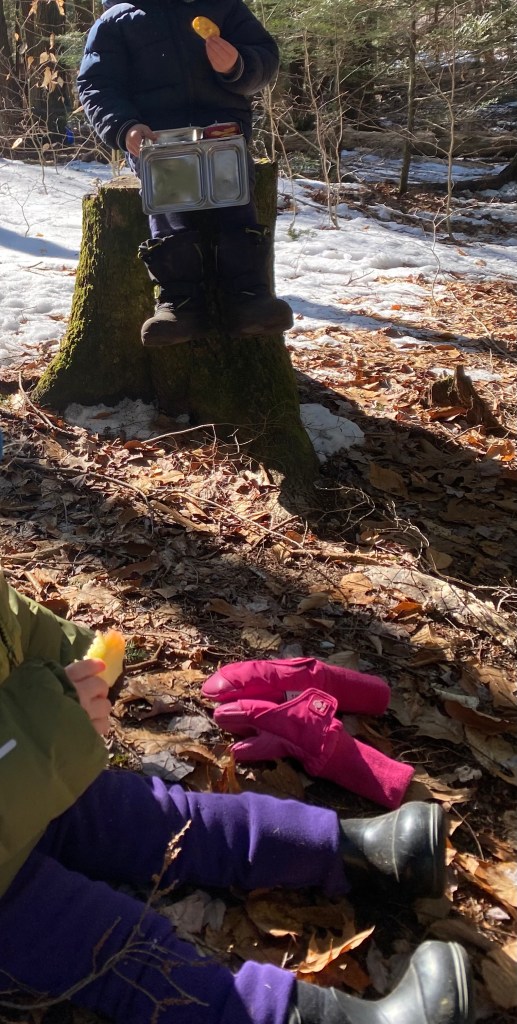
| Sit together to a share a snack or meal and sing, read aloud, or simply chat. |
| Exhales |
|---|
| Nature walks |
| Swinging |
| Gardening |
| Playing an instrument |
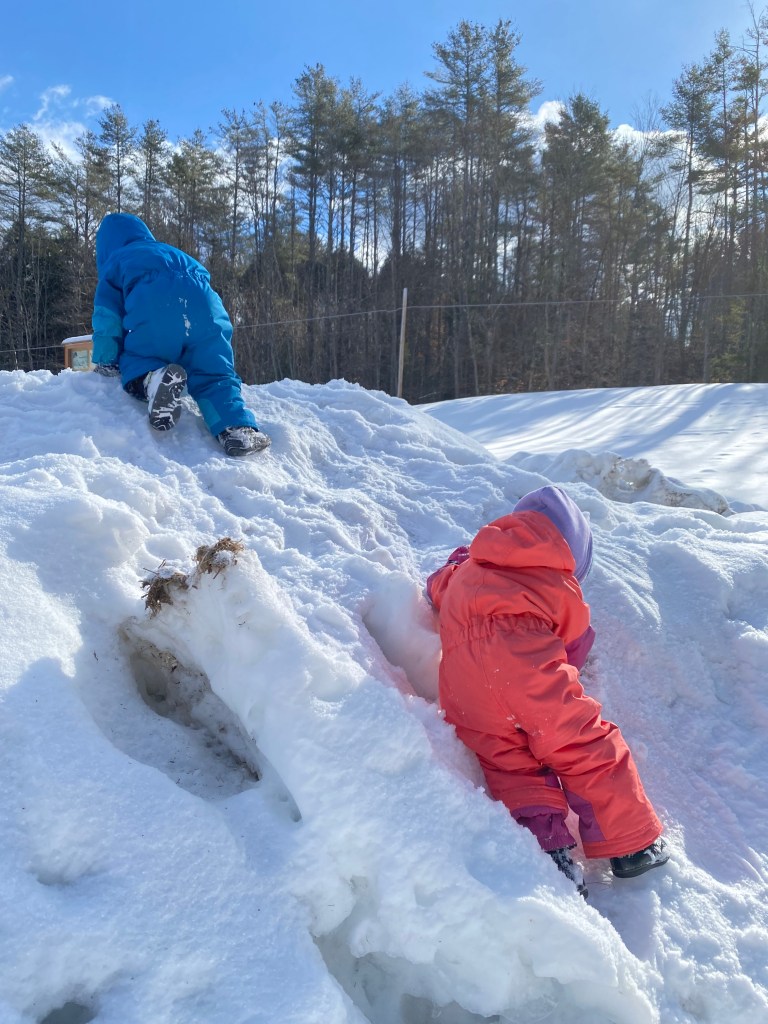
| Sledding or tubing |
| Sandpit play |
| Mud kitchen play |
| Teatime, a picnic, or snack (w/o added activities) |
| Play at a playground |
When we learn how to consciously lean into our children’s natural rhythms, we can build lives of peace and understanding. To build the space for our children to be able to move through their world harmoniously with their natural cycles is one of the greatest gifts we can give our children.



 thiswildandpreciouslife.com
Leave a comment