

Let’s talk about paper chains. Who hasn’t made a paper chain at some point in their life? Surprisingly, paper chains aren’t only fun to use as decoration, they also provide numerous opportunities to work on math and other skills.
I made the classic blunder of spilling the beans about an exciting trip to Boston a month in advance. The kids were understandably eager, asking every day how much time before we hit up the “aquarium”. I might as well have been reciting the alphabet backwards when I’d say any number name that exceeded the number of fingers on their little hands. Not only did some of these number words fall mostly on deaf ears- though there is something to be said about acquainting them with number names- but getting the to grasp the concept of time passing was like trying to teach them quantum physics. Saying “30” or “29” was basically useless and I might as well have been chatting up a brick wall.
Enter paper chains. I wanted the countdown to be enjoyable and also helpful for visualizing how many days remained. Visual aids can be especially helpful for a learner working with a challenging concept who needs a little support visualization. A paper chain is an excellent visual aid for the passage of time because it can be used as an interactive model and a visual depiction of a quantity. In this example, each link represents a day, and so it makes the quantity of days remaining more concrete.
Learning at Every Step
1. Measuring
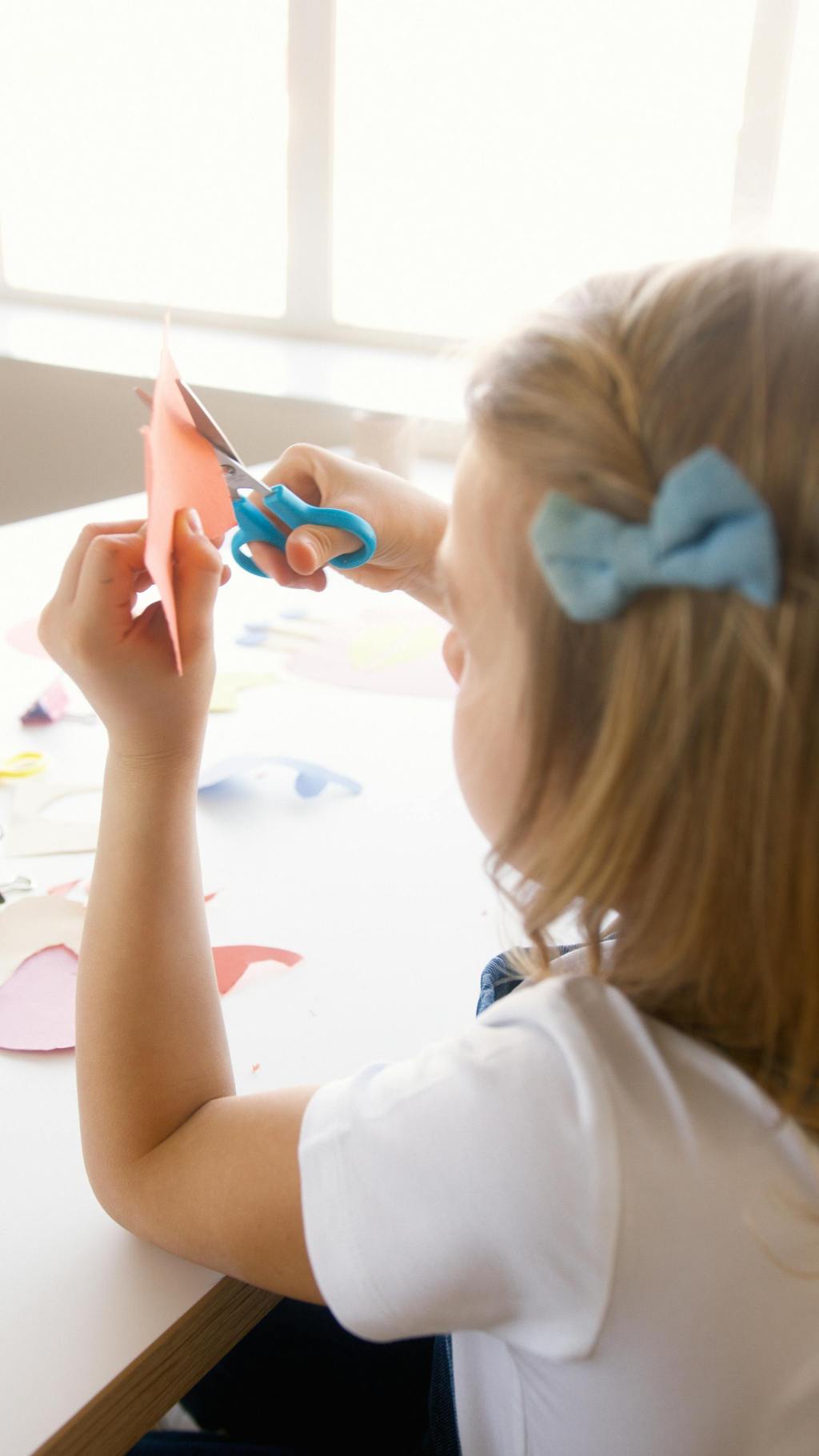
From the conception of this idea, I wanted my little learners to be involved in every step of making the chain. We started with cutting out 30 strips of paper. On a piece of standard construction paper, we drew 2 inch lines across the width of the paper so it could be cut in uniform strips.
2. Cutting strips of paper
My preschooler had been working on his cutting skills for some time with these scissors and cutting along the line was the perfect level of challenge for him. My youngest had a blast making paper confetti with these scissors and it was all good. It was saved to throw in the air the day we departed in celebration. As we cut, we chatted about the trip and our plans which was a perfect way to get us all pumped for the trip while also actively doing something with our hands.
3. Counting the strips
Counting and recounting is an obvious benefit for this activity. It’s easily adapted for any young learner as they can count to their ability. Every so often my preschooler would ask if we’d had enough. I made a number line and as we cut the strips we compared it to the number line. So he would count the strips to the highest value he could at the time (13), and then I would model the remainder up to 30. My toddler counted to 6 repeatedly and then watched as I modeled the rest. Everyone was able to practice for their specific stage and worked on a level appropriate for their ability. Asking questions such as “how many more do we need to get to x?” or “I cut x number of strips and you cut y, how many total do we have”, for early addition and subtraction work.
4. Arranging the strips in a pattern
Patterning work is a foundational math skill that gets built upon later in more advanced math concepts, and creating a paper chain is an interesting, hands-on way to work with patterns. Most little ones who likely couldn’t give two you-know-what’s about doing a pattern worksheet. This is a nice alternative that also has the brain and body working in harmony. Using a color pattern, our little learners naturally practiced identifying, understanding, and predicting the sequence of the colors in the chain. This understanding is spiraled back to as learners work with manipulating more complex patterns and numerical sequences such as skip counting and as well as growing/shrinking patterns. We chose a simple alternating pattern for our chain in an ABAB pattern, alternating two colors, as we’d only just begun patterning work.
5. Stapling the strips.
Stapling the strips lends itself well to hand-strengthening work. Period. That is all.
6. Counting down the chain.
Not a day passed that the kids forgot to cut off a strip. We incorporated it into our daily rhythm and our morning time around the table. Each day was an opportunity to compare the chain to the number line and to count backwards in a simple sequence. It was an easy way to invite them to work with simple addition and subtraction skills. “How many strips have we cut since we started?” or the much more fun question, “How many days do we have left until our trip”.
We used our paper chain as a countdown to an event, but there are so many exciting ways to incorporate paper chains into our learning. I’ve shared some of my favorites I’ve seen/used:.
Road trip countdown. A fun way to pass the time and curb the ever-popular and ever-obnoxious “are we there yet”! Maybe.
Holiday garland. It serves as both a decoration and a countdown to the special day. Double win.
Thanksgiving thankful chain. This was a fun activity our family did one Thanksgiving. We linked them together and read the thankfulness memos anonymously while we shared our Thanksgiving meal. It was a great way to take the pressure off sharing on the spot, yet it also bonded us in that moment.
Book list. Instead of keeping a list of books you’ve read, writing book titles on chain links turns into a fun visual motivator to keep reading!
Number sequencing. Another way to incorporate math skills is to cut out strips of paper with a number written on each. A fun way to practice putting the numbers in numerical order.
So make a paper chain with your little ones today. It’s a good time (and an educational one) for all involved!



 thiswildandpreciouslife.com
Leave a comment