
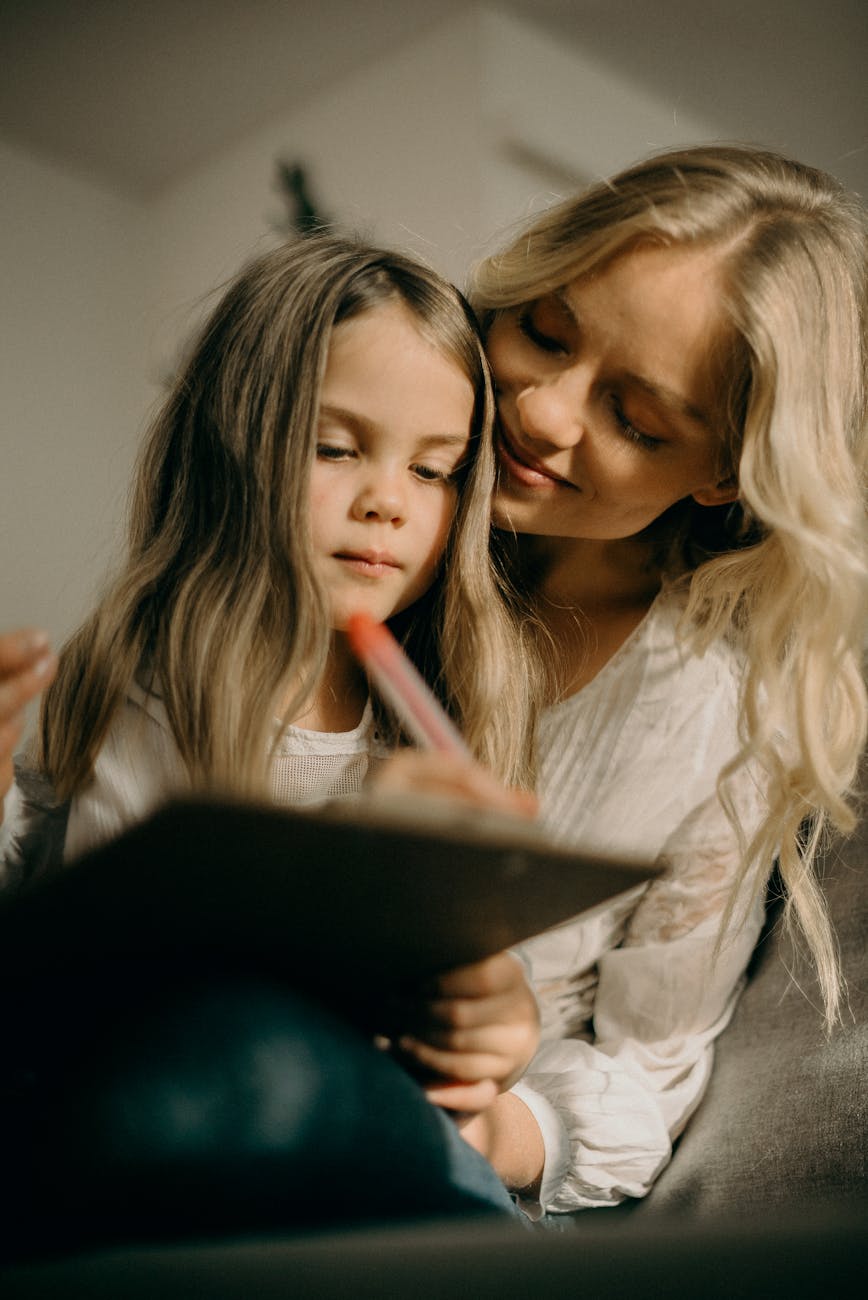
I’ve fallen into the same trap I’ve heard from many moms, “my kid isn’t doing x”. Raise your hand if you’ve ever feared that your child might fall behind. Everyone wants what’s best for their kids. Homeschooling can bring on immense pressure and the feeling that we want to give our kids the best possible education.
Reading and writing are the most important gateways into learning, and so it’s understandable that educators, home or otherwise, are anxious about our learners gaining these foundational skills.
Every child learns at their own pace. Humans go through distinct periods of development, each with unique brain changes and growth. Children are neurologically wired for specific types of learning during different ages and stages. A baby from birth to around 2 is learning to form bonds with their caregivers, a toddler is discovering independence, and a preschooler, around the ages 3-6, is moving into new explorations and formal learning with greater interest in numbers and letters. However, each of these “sensitive periods” can vary among learners. Just because a 4 year old isn’t writing doesn’t mean he or she is doomed to a life of illiteracy; it means he or she isn’t writing yet, and that’s okay. Your child might be working on other important learning, such as improving their gross and fine motor skills, and it can be ad relief when you have that realization.
Each child has a unique set of interests and traits, and therefore it’s important to provide the support needed by an individual learner so they can work on their needs and at a pace comfortable for their unique learning style. Don’t force it. A child is not going to learn if their sense of safety is threatened, and force can be threatening to (anyone’s) a child’s sense of safety
If we don’t force it, what do we do?
Working with an apprehensive (anything) writer is much like fishing. If you’ve ever been fishing, and even if you haven’t, you likely know that much of the activity consists of providing opportunity and patience. I’ve never met a fisherwoman whose strategy was to force fish onto her hook. That just doesn’t work. Instead, she casts out enticing opportunities, recasting from time to time, and then waits for the right moment.
You can lay down many gentle, engaging invitations for work, and be patient while you wait for a bite. You’ll never catch a fish if you don’t drop in a line, and increasing the times you try drastically increases the likelihood you’ll catch a fish and so creating invitations for work frequently drastically increases the likelihood your little one will accept and invitation for practice. So keep right on casting out ideas!
Three gentle open invitations for writing
Write in front of your child. Yes, it’s that simple. Modeling a skill is one of our most powerful influential tools as educators and parents. Our generation is plagued with using cell phones constantly for everything and anything. Need to make a grocery list? There’s an app for that. Need to tell your friend something? Text them instead of calling or writing a letter. In our modern mode of consumption over production we spend more time reading other people’s words than we do writing our own.

Let’s change that because there is so much to be gained from our child watching us write. When we write deliberately and slowly, little ones can observe how we hold our utensils, and how we form our letters, words, sentences, and paragraphs. It also helps them to see how we handle mistakes we make when writing, showing them that it’s okay to make mistakes when we write. In doing so, we are relieving pressure in getting it perfect when they do decide to pick up the pencil. Tip: Keep an extra utensil and piece of paper or notebook handy when you write, so the opportunity to write alongside you is there ready to go. No pressure, just an open invitation.
Here are a variety of ways you can write in front of your little one:
- Write a letter to a loved one
- Make a grocery list on paper
- Journal
- Use a paper planner
- Write down plans, appointments, and events on a calendar
- Budget on paper
- Create love notes to share with your kid
- Write poetry- FYI, you don’t need to be a writer to do this
- Draw pictures
- Fill out paperwork in front of your child
- Do math on paper instead of a calculator
Set up a pen pal situation. I have the coolest sister who loves snail mail. She’s been encouraging me to write letters back and forth since I left home for college. We continue to communicate via snail mail over a decade later. So, we thought it could be fun for the kids to also write and receive letters from auntie. Oh boy, has it been a hit. The kids are always excited when they get their piece of mail out of the mailbox with their names on it, and they can’t wait to read and respond to her letters.

Again, I don’t force the writing bit. Instead, we’ve slowly built up to more of that over time starting with me transcribing thoughts to my preschooler signing the letter, and now him writing letters and stuffing envelopes independently at times. They are still illegible and full words aren’t yet formed, and who cares. I recommend adding a dash of whimsy by providing fun supplies for embellishments.
- Use washi tape
- Add stickers
- Pick out cool pens with your kiddo
- Let your kids pick out unique stationary and envelopes
- Fold your own envelopes- there are many tutorials on Pinterest
- Take trips to the post office together to pick out and purchase stamps
Offer alternative ways to form letter and number symbols. Writing doesn’t have to start with forming symbols with a utensil. In fact, until enough muscles and therefore fine motor skills in the hands are developed, a writing utensil won’t even be accessible for a child to use anyway. Instead, you can find other ways to explore writing and forming letters and numbers. They will be more interested in forming letters, if you appeal to their unique interests. Try different ideas and see which mediums your kiddo enjoys.

- finger painting with various mediums such as shaving cream, salt, sand, mud (yep), foaming soap, or yogurt.
- shaping letters using play doh or modeling clay. The Treehouse Schoolhouse mats are a wonderful resource we’ve loved to guide such activities.
- Use bread dough to shape letters and bake fun bread “sticks” together. Bonus, you can use the breadstick letters to form words after they’ve baked to continue the fun.
Bottom Line
We want our little ones to be lifelong learners and to accomplish that goal, our kids need to find the learning process pleasurable. This does not happen through force or coercion, and instead is done by keeping it light and fun. Remembering that kids progress through unique ages and stages at a unique pace can help us keep our own thoughts and expectations around their learning in check. It’s my hope you rest assured in that factoid as you try out some of these simple gentle techniques so that both you and your child can learn alongside one another with the confidence and peace that keeps the learning process fun and enjoyable.



 thiswildandpreciouslife.com
Leave a comment